2. Results

CLAN TAKE-HOME MESSAGES

  1. Animals actively contribute to the construction of contemporary families: relational + affective
  2. The animal is contributing to the child's development as a unique individual within the family dynamic; the same applies to other family members
  3. Responsibility as an educational goal versus what happens in practice (reduced or non-existent participation of children in animal-related tasks; participation is very limited by a busy schedule)
  4. Animals (indirectly) educate children as “adults (responsible) in the making,” since child-animal relationships create a universe that does not seem to be immediately or directly linked to school and “schooling.” And parents' values and educational goals in relation to animals do not translate into skills directly geared toward school.
  5. Children's experiences do not always coincide with the (family) imagination surrounding companion animals: species, breeds, individuals.
  6. Just as the “families we live with” are different from the “families we live in,” the animals children live with are different from those they have lived with (or live with) (imagined). This can lead to conflicts and challenges.
    • means that the dimension of the imaginary must be addressed, since it is fundamental to framing and shaping everyday practices with animals.
    • It also means that family memories and past experiences with animals should be analyzed, as they shape the family's imagination and choices.
  7. Photographing the animal was a way to get the children to pay attention to pets and reflect on their relationships with them
    • This extends to the family's relationships with animals: children's reports are inclusive, as they encompass many different types of personal ties: extended family, friends, schoolmates, neighbors
      Children's visual narratives about the lives of animals show that sharing space is crucial, as family dynamics are marked by common spaces and activities (kitchen, dining table, bedroom and bed, living room and sofa, etc.)

  •  

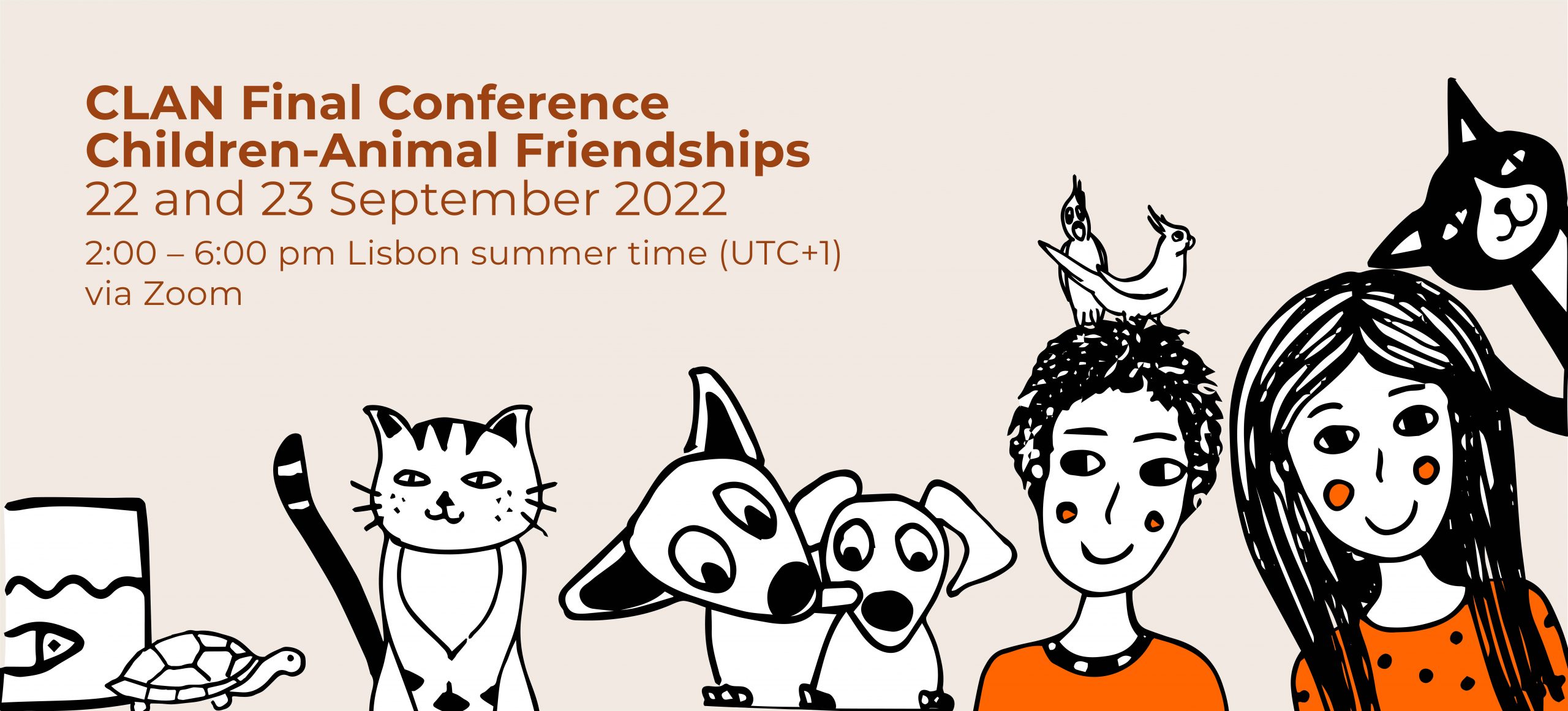
CLAN Conference

Friendship between children and animals

The CLAN International Conference took place on September 22 and 23, 2022. This conference brought together invited experts in the field and researchers involved in the project to discuss the topic. On the first day, we delved into the theoretical reasoning behind the specificities of child-animal relationships and their status in the field. We also presented some of our results, putting them into perspective with the state of the art.

On the second day, we addressed one of the most important dimensions of the project: how to go beyond academia and reach wider audiences of all ages and backgrounds. We discussed how to engage and give back to participants. And how art and science can work together to communicate a multispecies, more-than-human approach that can have an impact on the well-being of children, animals, and families.

Teses | Projetos de Doutoramento

Autor: Henrique Tereno

Programa Doutoral: Sociologia (OPENSOC)

Instituição: Instituto de Ciências Sociais, Universidade de Lisboa

Orientadora: Verónica Policarpo

Título: Building the Animal: Processes of categorization of nonhuman animals in children

Resumo:

V


Autor: Clara Venâncio

Programa Doutoral: Design 

Instituição: Faculdade de Belas Artes, Universidade do Porto

Equipa de Orientação: Verónica Policarpo

Título: ALIVE | Human-Animal Living: Designing with families for more-than-human cohabitation

Resumo:

X

Scroll to top